

What AI Actually Fixes Inside a Clinic
I have watched AI medical billing systems surface undercoded encounters and recover thousands of dollars in revenue that practices had already earned but never captured. I have watched automated reactivation campaigns bring back no-shows and lapsed patients by the dozen. I have watched front desk AI handle calls and texts at 2 a.m. and book patients who would otherwise have hung up.
And then there are the AI scribes. They are being adopted across American medicine faster than the EHR itself was, which is ironic, because most clinicians are using scribes specifically to avoid dealing with the EHR. All of this is real, measurable, and repeatable. It is the foundation of why I am an unabashed AI optimist when it comes to clinic operations.
The Sea Change AI Scribes Created for Clinicians
Before I get into the part where my optimism hit a wall, I want to be clear about what scribes have done for the doctors I work with. I used to own clinics. I watched my doctors burn out from endless late nights spent charting after the kids were asleep. AI scribes are not just giving them their nights and weekends back. They are capturing patient encounters with more accuracy, leading directly to more comprehensive billing, and letting clinicians give better care because they are not heads-down in a laptop the entire visit.
These systems have transformed "pajama time" from a dystopian phrase about working late into, wait for it, actual pajama time. That alone is enough to make a believer out of most operators. It is what made one out of me. And it is what sent me rushing headlong into automating my client's prior authorization workflow.
When I Tried to Automate Prior Auth
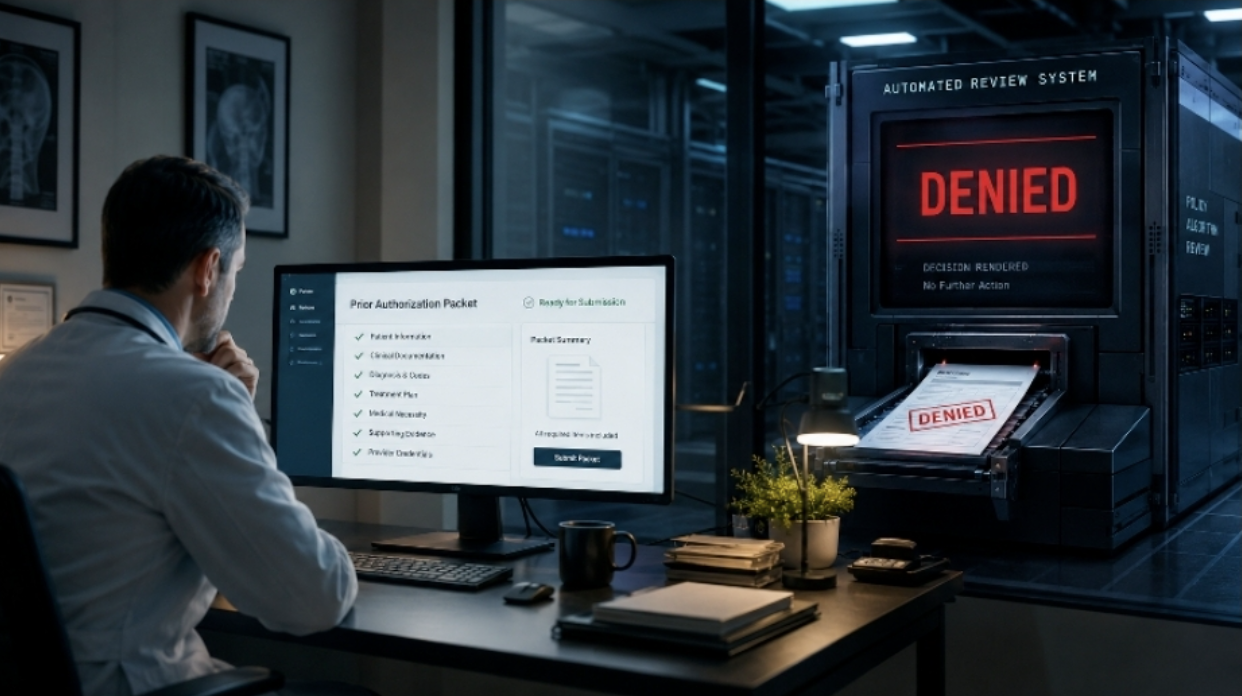
It was not difficult to install. Plenty of startups are doing the exact same thing. You plug an AI agent into the EHR, point it at the prior authorization forms, and bingo, you just saved 30 minutes of administrative work. Review the result, send it off, and then wait.
…for the denial.
I did not realize what had happened until I asked my client how the agent was doing. He said it was great. More thorough, more accurate, faster. And the denial? That was just part of the game they play with insurance companies. He had hoped a more thorough request might change the outcome. It did not. New technology, same old problem.
The Carnival Act of Prior Authorization
According to KFF, about a third of insured adults say their insurer has denied a treatment or medication their doctor prescribed. One in ten denials gets appealed. After a few days of waiting, more than 80 percent of those appeals are granted.
It is a carnival act. Jump through the hoops and you can have your medication. With AI, my clients can jump through those hoops faster, but they are still jumping through hoops. So I started looking into how the system actually works under the hood. This will not be news to most physicians, but it was a wakeup call for me.
Why Initial Denials Are Not Really Decisions
The initial denial is rarely the result of clinical analysis. It is a binary decision driven by guidelines. If a doctor wants the case actually analyzed, they have to appeal. Sometimes twice. Sometimes by insisting on a peer-to-peer call with another physician. It is an absurd system, and a broken one.
Physicians are also late to this game. Insurers have been automating prior authorization for more than a decade, and the data shows denial rates climbing as they did. After UnitedHealth's Medicare Advantage plans started using an algorithm called nH Predict in 2019, the denial rate for post-acute care more than doubled, according to a 2024 Senate investigation. The company is now being sued after a patient died, allegedly due to a prior auth denial. UnitedHealth refutes the claim and is fighting it in court.
The Insurer Pledge, And Who Actually Believes It
For their part, insurers say they are building new AI-powered programs that will fix this. More than 50 of them signed a pledge in June 2025 committing to simplify prior authorization, including real-time approvals on 80 percent of electronic requests by 2027.
You know who believes them? About one third of doctors, according to a recent AMA survey. I cannot speak for the other two thirds, but I know what I hear from my clients. They can guess what an AI-powered program looks like when it is built on top of the same guidelines that have been generating denials all along.
The WISeR Model and the Wiring Underneath
We do not actually have to guess, because it is already happening. In January, Medicare launched a pilot called the WISeR Model, a six-state program where private tech firms were hired to implement AI agents to handle prior authorizations for certain Part B services. Those firms are paid a share of the savings their models generate. CMS insists they are paid to "get it right," not to deny.
But strip away the language and look at the wiring: a private company's revenue goes up every time a patient gets a no. I am a salesman at the end of the day. I know the only rule in business is to make money. But my business is helping clinicians. Their business is helping patients. I hate having to tell them about the asterisk next to the prior authorization AI agents, an asterisk I cannot fix with a better model or a more robust training regimen.
A Smarter Algorithm Pointed at the Same Incentive
There used to be a business case for guideline-driven decisions. That case does not really hold anymore. Assuming we keep a human in the loop for every denial, we can absolutely automate analysis. We can build a new system unconstrained by the processing limitations that justified guideline-based gating in the first place. But will it happen?
Insurers do not deny because their models cannot reason. They deny because denial pays. A smarter algorithm pointed at the same incentive just denies you more precisely. It is old systems dressed up in AI clothing. The technology to actually weigh a patient's history instead of pattern-matching against a guideline already exists. Insurers could build it tomorrow. I just do not know if they will.
What I Tell My Clients Now
When a clinic owner asks me to automate their prior authorization workflow, I tell them the truth. Their end of the process will get cleaner, faster, more thorough, and more efficient. We can build the AI workforce that handles the form, pulls the right chart data, attaches the right clinical evidence, and sends the request out in a fraction of the time it used to take staff. That part is real, and it is worth doing.
What I cannot fix is the other side of it. The denial is not a technology problem on the clinic side. It is an incentive problem on the payer side. Until that incentive changes, the most honest thing I can do is help practices win every dollar that is winnable on their side of the wire, which is more than most owners realize.
If you want a clear-eyed look at where AI will actually move revenue in your practice (and where it will not), start with the free 5-minute AI Readiness Assessment, or book a 30-minute strategy call and we will map your highest-leverage first system together.