

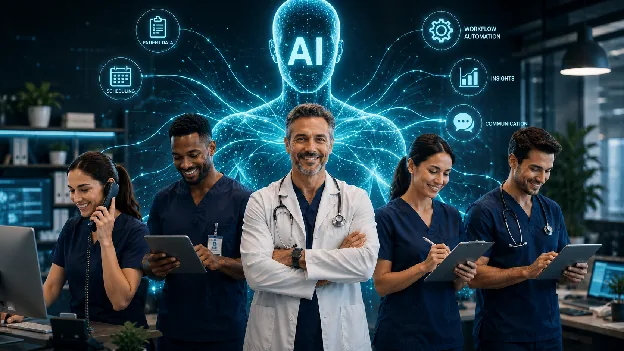
Healthcare Doesn't Have a People Problem. It Has a Time Problem.
I understand why these conversations create fear because I hear the same concerns almost every day. Every time I publish something about AI, the comments start filling up. Some people tell me AI is destroying jobs. Others say I'm helping replace healthcare workers. A few even argue that healthcare should never use artificial intelligence at all.
The truth is, I don't get offended by those comments. Most people asking those questions aren't trying to be difficult. They're trying to understand where healthcare is headed and whether their careers, their businesses, or even the quality of patient care are at risk. Those are fair questions, and they deserve honest answers instead of clickbait headlines designed to create fear.
After spending years helping medical practices, dental offices, chiropractic clinics, and functional medicine practices implement AI, I can confidently say the reality looks nothing like the story many people are being told online. I'm not walking into practices where doctors are replacing nurses with software or firing front desk employees because they installed an AI tool. What I see is something completely different. I see overwhelmed teams finally getting help with the repetitive work that has been stealing their time for years.
That distinction matters because there's a huge difference between replacing a healthcare professional and eliminating repetitive administrative tasks. Unfortunately, those two ideas often get lumped together, creating unnecessary fear and causing some practice owners to avoid technology that could actually make life better for both their staff and their patients.
This article isn't about convincing you that AI can do everything. In fact, I believe some of the biggest promises being made about AI today are unrealistic. My goal is much simpler. I want to show you where AI genuinely adds value, where human beings will always be essential, and why the practices that learn to combine both will have a significant advantage over the next decade.
Talk to almost anyone working in healthcare today, and you'll hear a common theme. Doctors feel buried in documentation. Nurses spend too much time entering information into electronic health records. Front desk teams juggle constant phone calls, insurance questions, appointment scheduling, and patient follow up. Office managers spend countless hours moving information between software systems that don't communicate with one another.
None of those responsibilities are why someone chose a career in healthcare. No physician spent years in medical school dreaming about finishing charts late into the evening after everyone else had gone home. Nurses didn't enter the profession because they enjoy paperwork, and receptionists certainly don't look forward to answering the same insurance questions dozens of times every day. Yet somewhere along the way, administrative work slowly began consuming more and more of the healthcare experience, leaving many professionals feeling like they spend as much time serving computers as they do serving patients.
It's one of the biggest reasons burnout continues to affect healthcare organizations across the country. In fact, the American Medical Association has found that physicians consistently rank reducing administrative burden as one of the most valuable uses for artificial intelligence. Most aren't asking AI to diagnose patients or replace clinical decision making. They're asking for help with the repetitive work that keeps them in the office long after their last patient has gone home.
That says a lot about where the real opportunity exists. Healthcare professionals aren't looking for AI to replace them. They're looking for AI to give them their time back.
AI Doesn't Replace Healthcare Professionals. It Replaces Repetitive Work.
One of the biggest misconceptions I hear is that healthcare workers and AI are somehow competing against each other. That's simply not how successful AI implementation works.
Artificial intelligence is exceptionally good at handling structured, repetitive, and predictable tasks. It can organize information, draft documentation, summarize conversations, automate reminders, answer common questions, and move data between systems far faster than a human can. Those are important jobs, but they're also jobs that rarely require empathy, experience, or clinical judgment.
Healthcare, on the other hand, depends on qualities that technology simply cannot replicate. Patients don't remember a great appointment because someone scheduled it quickly. They remember how their physician listened to them when they were scared. They remember the nurse who made them feel comfortable before a procedure. They remember the treatment coordinator who patiently explained their options and helped them feel confident about moving forward.
Those moments are built on trust, compassion, communication, and experience. They require emotional intelligence, critical thinking, and human connection. No matter how advanced artificial intelligence becomes, those qualities remain uniquely human, and I don't believe that will change anytime soon.
That's why I don't look at AI as a replacement for healthcare professionals. I look at it as a way to remove the distractions that keep them from doing the work only they can do. When repetitive tasks are automated, healthcare teams gain something far more valuable than efficiency. They gain time. Time to educate patients, strengthen relationships, improve outcomes, collaborate with coworkers, and sometimes even make it home in time for dinner with their families.
That's not replacing healthcare workers.
It's helping them become even better at what they already do.
The Biggest Mistake Practices Make When They Think AI Is a Replacement
One of the biggest misconceptions I see isn't coming from people who are against AI. Surprisingly, it often comes from practice owners who are excited to implement it. They assume artificial intelligence will allow them to reduce staff, cut payroll, and let software handle most of the day-to-day operations. While that might sound appealing on paper, it almost always leads to disappointment because it's based on the wrong expectation.
I've never believed AI should replace good employees. In fact, I think that's one of the fastest ways to fail with AI. Technology works best when it supports your team, not when it tries to become your team. Every healthcare practice is built on relationships, trust, communication, and clinical expertise. Software can't replicate those things, and it shouldn't try to.
When I begin working with a new practice, the conversation is never about who can be eliminated. Instead, I ask a much more important question: Where is your staff wasting time every single day? That's where the real opportunity exists. Almost every office has repetitive tasks that consume hours every week without improving patient care. Those are the areas where AI can make an immediate impact.
Maybe your front desk spends two hours every morning returning missed phone calls and confirming appointments. Maybe your treatment coordinator manually follows up with every website lead, sending the same emails and text messages over and over again. Your office manager might spend hours moving information between different software systems because none of them communicate with each other, while your providers stay late every evening trying to finish documentation before they can finally go home.
Those aren't people problems. They're workflow problems, and solving them doesn't require fewer employees. It requires giving your employees better tools.
Imagine what happens when those repetitive responsibilities disappear. Your treatment coordinator suddenly has more time to educate patients, answer questions, and help people feel confident moving forward with care. Your front desk can spend less time chasing phone calls and more time creating an exceptional first impression for every patient who walks through the door. Providers can leave the office on time instead of spending another two hours catching up on documentation after everyone else has gone home.
The employees didn't become less valuable because AI entered the picture. They became more valuable because they finally had the time to focus on work that actually requires a human being.
That's the difference between replacing employees and empowering them, and it's a distinction that gets overlooked far too often.
The Healthcare Jobs Becoming More Valuable Because of AI
Whenever a new technology emerges, people naturally assume fewer workers will be needed. History has shown us something very different. New technology usually changes how people work rather than eliminating the need for them altogether, and healthcare is no exception.
Think back to when electronic health records became standard. Paper charts didn't disappear because doctors suddenly stopped seeing patients. Digital imaging didn't eliminate radiology departments, and online appointment scheduling didn't make front desk employees unnecessary. Those technologies changed workflows, improved efficiency, and allowed practices to serve patients differently, but skilled healthcare professionals remained at the center of everything.
Artificial intelligence is following that same path.
In many ways, AI is actually making healthcare workers more valuable because it's removing the tasks that keep them from practicing at the top of their abilities. A physician should be diagnosing, educating, and building trust with patients, not spending hours formatting notes. Nurses should be focused on delivering exceptional care instead of constantly updating records. Treatment coordinators should be helping patients understand their options rather than manually sending the same follow-up emails every day. Office managers should be improving operations and leading their teams instead of spending hours pulling reports and copying data between systems.
Notice what all of those examples have in common. AI isn't taking away meaningful work. It's taking away repetitive work so healthcare professionals can spend more time doing what only they are qualified to do.
That's exactly why I believe the value of skilled healthcare employees will continue to grow. As technology handles more routine administrative work, human skills like empathy, communication, leadership, problem solving, and clinical judgment become even more important.
Why Human Judgment Will Always Matter
This is one area where I think some people dramatically overestimate what AI can actually do. It's incredibly powerful, but it's still a tool. It doesn't have life experience. It doesn't understand emotion the way people do, and it certainly doesn't accept responsibility for the decisions being made inside a healthcare practice.
A patient who's anxious about a diagnosis doesn't simply need information. They need reassurance from someone they trust. A family making a difficult healthcare decision wants compassion, guidance, and honest conversation. Sometimes the most important part of an appointment isn't the treatment itself. It's the confidence a patient feels after speaking with someone who genuinely cares about them.
Artificial intelligence can't create those moments because they're built on human connection, not technology.
That's why I believe AI should always function as an assistant rather than the decision maker. It can organize information, summarize conversations, draft documentation, identify trends, and automate repetitive workflows, but the final judgment should always belong to a qualified healthcare professional. The technology makes the clinician more efficient, while the clinician makes the technology more valuable by applying experience, ethics, and critical thinking.
That's the partnership I believe every healthcare practice should be building.
Burnout Is the Real Problem We Should Be Talking About
If we're going to have an honest conversation about AI in healthcare, I think we're asking the wrong question. Instead of asking whether AI will replace healthcare workers, we should be asking why so many healthcare professionals are exhausted in the first place.
Across nearly every specialty, providers are being asked to do more than ever before. Patient demand continues to grow, documentation requirements become more complex every year, and staffing shortages have left many practices trying to accomplish more with fewer resources. It's no surprise that burnout has become one of the biggest challenges facing healthcare today.
The Association of American Medical Colleges projects the United States could face a shortage of up to 86,000 physicians by 2036, making it even more important for practices to use technology wisely. AI isn't going to solve that shortage by replacing doctors. It can, however, help existing healthcare teams become more efficient by reducing the administrative burden that consumes so much of their day.
When documentation takes minutes instead of hours, providers get home earlier. When appointment reminders and routine patient communication happen automatically, front desk teams can focus on creating a better patient experience. When repetitive administrative work is handled by AI, everyone on the team has more time to focus on the work that actually improves patient care.
That's why I believe the conversation shouldn't be about replacing healthcare workers at all. It should be about giving them the tools they need to enjoy practicing healthcare again while delivering an even better experience for the people who depend on them.
What AI Actually Looks Like Inside a Modern Healthcare Practice
One of the reasons there's so much confusion around AI is because most people have never seen it working inside a real healthcare practice. They picture robots diagnosing patients, computers replacing receptionists, or software making clinical decisions on its own. That's the version Hollywood likes to show us, but it's not the version I see every day.
The reality is much less dramatic and much more practical.
When I help a practice implement AI, we're usually looking for dozens of small improvements that add up to a significant transformation. Instead of asking AI to replace employees, we're asking it to eliminate friction throughout the patient journey so the entire team can work more efficiently.
For example, a patient may fill out a form on your website after business hours asking about treatment options. Instead of waiting until the next morning for someone at the front desk to respond, an AI assistant can answer common questions immediately, collect the information your team needs, and even help schedule an appointment. When your staff arrives the next morning, they're not starting from scratch. They're simply picking up the conversation and providing the personal care that only a human can deliver.
The same principle applies throughout the practice. AI can draft follow up emails after appointments, organize patient information, summarize documentation, remind patients about upcoming visits, generate marketing content, monitor online reviews, assist with internal workflows, and even help analyze operational data so practice owners can make better business decisions. None of those tasks require eliminating employees. They simply reduce the amount of repetitive work your team performs every day.
When enough of those small improvements are combined, the result is something much bigger. Staff members feel less overwhelmed because they're no longer buried under administrative work. Providers spend more time treating patients instead of typing notes into a computer. Patients receive faster responses and more consistent communication, while practice owners gain greater visibility into what's happening inside their business.
That's what successful AI implementation actually looks like. It doesn't replace people. It removes obstacles that prevent people from doing their best work.
The Practices That Will Thrive Aren't the Ones With the Fewest Employees
There's another misconception I hear quite often. Some people believe practices that avoid AI are somehow protecting jobs. While I understand the intention behind that thinking, I don't believe that's what will happen over the next decade.
Healthcare is becoming more competitive every year. Patients expect faster communication, shorter response times, online scheduling, personalized experiences, and convenient access to information. At the same time, practices continue facing staffing shortages, rising operating costs, increasing documentation requirements, and growing patient demand.
Ignoring AI doesn't make those challenges disappear. It simply means your team has to continue solving them manually while other practices begin using better tools.
The practices that succeed won't necessarily have fewer employees. In many cases, they'll have the same number of employees or even more. The difference is that those employees will be spending their time building relationships, educating patients, improving the patient experience, and supporting practice growth instead of performing repetitive administrative tasks that software can complete in seconds.
That's an important distinction because growth creates opportunity.
As practices become more efficient, they're often able to serve more patients without overwhelming their existing staff. Increased efficiency can lead to increased revenue, which allows practices to invest in new services, expand locations, hire additional providers, and create even more career opportunities. AI isn't stopping growth. In many cases, it's making growth possible.
AI Is Here to Stay. The Question Is How You'll Use It.
Whether someone loves artificial intelligence or hates it, one thing is becoming increasingly clear. AI isn't a passing trend.
Every major technology company is investing billions of dollars into artificial intelligence. Healthcare software companies are rapidly integrating AI into electronic health records, patient communication platforms, scheduling systems, documentation tools, and operational software. Universities are teaching future healthcare professionals how to work alongside AI, and new applications are being introduced almost every week.
None of that means healthcare professionals are becoming obsolete.
It means the way we work is changing, just like it has with every major technological advancement throughout history.
The practices that embrace AI thoughtfully and responsibly will have an advantage because they'll spend less time fighting inefficient processes and more time focusing on exceptional patient care. Those that ignore it entirely may eventually find themselves struggling to compete, not because they lack talented people, but because they're asking those talented people to spend too much of their day doing work that technology can now handle.
That's why I believe the conversation shouldn't be centered around whether AI is replacing healthcare jobs. The real conversation should be about how healthcare leaders can use AI responsibly to support their teams, reduce burnout, improve patient experiences, and build stronger practices for the future.
The Future of Healthcare Still Belongs to People
After years of working with healthcare practices across the country, I've become more convinced of one thing than ever before. The future of healthcare isn't about choosing between people and artificial intelligence. It's about helping people use artificial intelligence to become even better at what they already do.
Every practice I work with has one thing in common. The providers didn't choose healthcare because they wanted to spend their evenings catching up on documentation or manually following up with leads. They chose healthcare because they wanted to improve lives, solve problems, and make a meaningful difference for their patients. Somewhere along the way, administrative work slowly began taking over, leaving many talented professionals feeling exhausted before the day was even finished.
That's exactly why Justin Healthcare AI exists.
My mission has never been to help practices replace employees. It's to help them remove the repetitive work that's preventing their teams from reaching their full potential. When AI is implemented the right way, doctors spend more time practicing medicine. Dentists spend more time educating patients. Chiropractors spend more time helping people move and feel better. Office managers become leaders instead of data entry specialists, and front desk teams become relationship builders instead of spending their entire day answering the same questions over and over again.
I also believe something that's becoming increasingly important as AI continues to evolve. Every healthcare practice should have a clear strategy for where AI belongs and where it doesn't.
Not every task should be automated.
Not every workflow needs artificial intelligence.
Most importantly, not every decision should ever be left to software.
Clinical judgment, empathy, trust, ethics, experience, and meaningful conversations will always require people. Those qualities are the foundation of exceptional healthcare, and no technology can replace them. AI should strengthen those human interactions by removing unnecessary administrative work, not replace them.
That's why I spend so much time teaching healthcare professionals how to implement AI responsibly. It's easy to get caught up in flashy software demonstrations and promises that AI can solve every problem. The reality is much different. Success comes from identifying the right opportunities, choosing the right tools, protecting patient information, maintaining HIPAA compliance, and making sure every implementation supports your team instead of disrupting it.
When AI is introduced with that mindset, something remarkable happens. Practices become more efficient without losing the personal touch that patients value. Employees feel less overwhelmed because repetitive tasks no longer dominate their day. Providers regain valuable hours that can be invested in patient care, continuing education, business growth, or simply spending more time with their families. Patients benefit from faster communication, better organization, and a smoother overall experience, while still receiving the compassion and expertise that only another human being can provide.
I don't believe practices that ignore AI are protecting jobs. I believe they're making life harder for the talented people they already have. As technology continues to improve, healthcare organizations that embrace it responsibly will be able to reduce burnout, improve patient experiences, and create stronger, more sustainable businesses. Those that refuse to adapt may eventually find themselves falling behind, not because they lack great employees, but because they're asking those employees to solve tomorrow's challenges with yesterday's tools.
Artificial intelligence isn't replacing healthcare.
It's helping healthcare get back to what it was always meant to be.
Less paperwork.
Less busy work.
More conversations.
More relationships.
More time with patients.
More time doing the work that truly matters.
So let’s end on this note…AI isn't the future of healthcare. People are! AI is simply another tool that can help us become better at what we do. Used the right way, it won't replace the people who make healthcare great. It will give them more time to do what only they can do. I don't want to see healthcare workers replaced. I want to see them supported, empowered, and given the freedom to focus on the people who need them most. To me, that's what AI should always be about.
That's the future I'm working toward every day, and it's exactly what I help practices build at Justin Healthcare AI.
If you're wondering where AI could create the biggest impact inside your own practice, take the free 5-minute AI Readiness Assessment and discover where your greatest opportunities exist. Or book a free 1:1 AI Strategy Call with Justin Ingram for a personalized roadmap.