

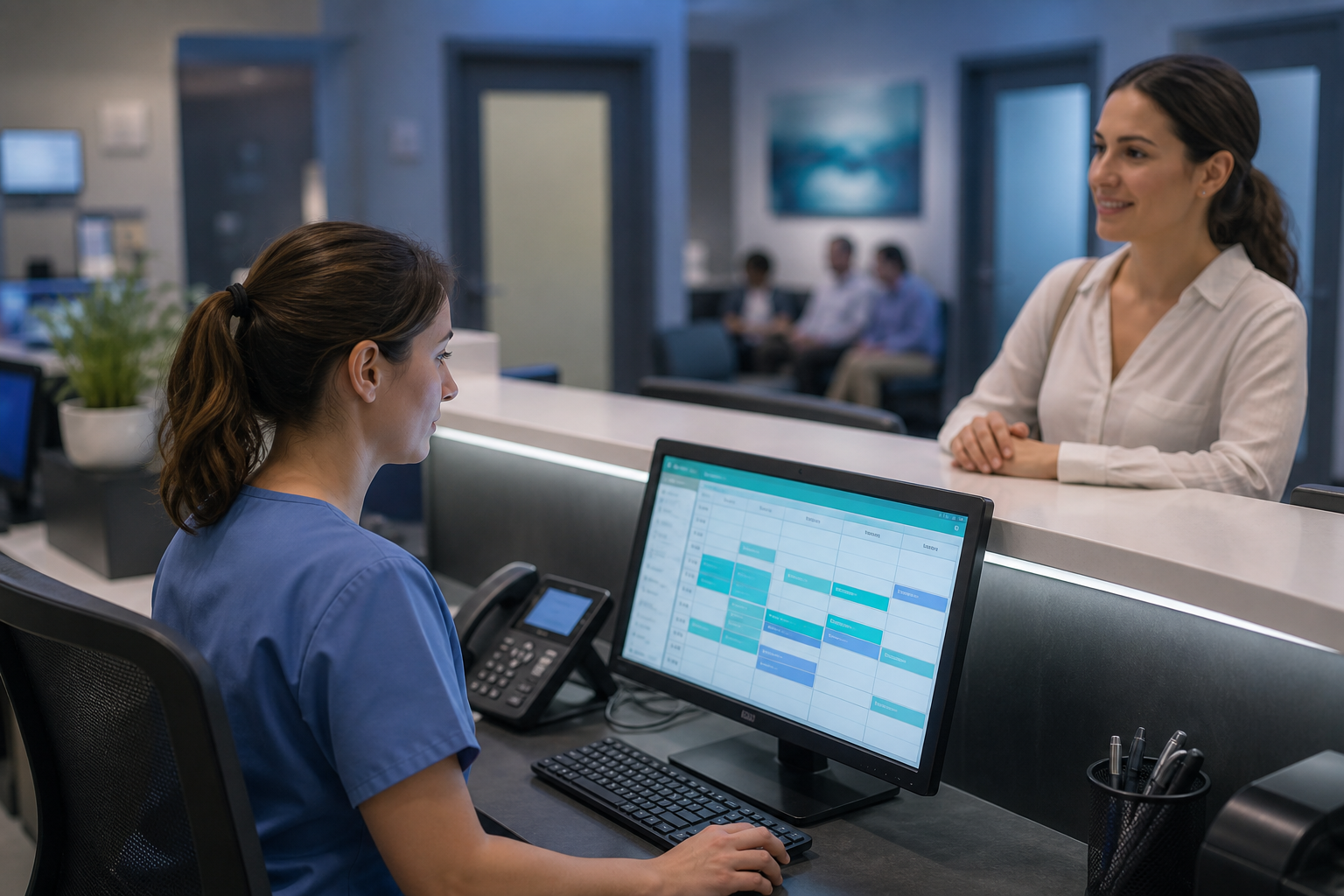
Your Patients Now Expect Instant Scheduling Help
Patients are now mobile-first. They grab their phone, not to call, but to text, tap, or use a web form. They want 24/7 access to scheduling, fast answers about visit types and openings, and clear next steps without sitting on hold.
During summer, clinics see a rush of travel visits, elective procedures, and last-minute questions before people leave town. As back-to-school season hits, there is another spike for sports physicals and required shots. Front desks get slammed, especially in larger systems with many locations.
When that happens, it is common to see missed calls and full voicemails, long hold times and upset patients, and staff trying to juggle phones, walk-ins, and internal messages.
So the real question becomes: can AI scheduling software for healthcare meet or even beat the standard of a human front desk, while staying HIPAA compliant and fitting the way your clinics already work?
What AI Scheduling Software Really Does Today
Modern AI scheduling tools are not just online calendars. When they are built for healthcare, they usually include:
- Conversational intake over phone, SMS, and web • Basic insurance and eligibility checks • Matching patients with the right provider, room, and location • Automated reminders and follow-up messages tied into your systems
The big difference is between a simple online booking widget and a true AI scheduling engine. A widget might let patients grab an open slot, but it will not understand visit types and time blocks, insurance rules and referral needs, or provider preferences or location-specific rules.
An AI engine, when wired into your EHR and practice management tools, can use those rules to guide patients to the right spot. Still, there are limits. AI can struggle with very complex edge cases, unclear or mixed instructions, or emotionally heavy situations. That is why successful deployments typically rely on a hybrid approach with strong operational structure:
- Clear guardrails • Human backup for tricky or sensitive calls • Ongoing tuning as your workflows change
Front Desk vs. AI Workforce in Real Clinic Workflows
A strong human front desk does much more than answer phones. In a normal day, staff might:
- Triage calls and decide what is urgent • Verify demographics and insurance details • Route messages to nurses or providers • Manage waitlists and last-minute openings
An AI workforce can take on many of these steps, especially repeatable ones, and it can do this around the clock for all your locations at once. For example, AI can handle:
- Routine scheduling and rescheduling • Basic intake questions and reminders • Simple billing questions like “Did you get my payment?”
In a hybrid model, humans still play a key role by focusing on the work that is harder to standardize and higher risk if handled incorrectly. Staff focus on:
- Escalations and urgent concerns • Complex or confusing insurance issues • In-person experience and sensitive conversations
Many front-desk teams worry about job loss or losing that warm personal touch. What we see instead is that AI removes some of the most repetitive, error-prone tasks. That can lower burnout and free people to do the work that truly needs a human, like calming a worried parent or helping a patient with a complex care plan.
Safety, Compliance, and Trust in AI-Driven Scheduling
Healthcare AI always has to respect privacy. HIPAA-compliant AI scheduling software for healthcare must protect patient information across every channel, including:
- Phone calls and call recordings • SMS and web chat conversations • Email reminders and confirmations
It also needs secure connections into your EHR and billing systems without leaking data or exposing more than is needed. Strong governance usually includes:
- Audit trails that show who did what and when • Role-based access, so AI only touches what it must • Standard scripts for sensitive topics • Clear rules for when to hand off to a human
Patient trust is just as important, and it tends to come from consistent experiences over time. In practice, that means being upfront that they are talking with an AI assistant, giving accurate and consistent information, offering language options where possible, and following through on what the AI promises, like sending a confirmation.
Trust builds slowly, one accurate interaction at a time.
Proving ROI Before You Reshape Your Front Desk
Before changing staffing, clinics often want proof that AI works in their world. Helpful measures include:
- No-show rates, especially for high-demand slots • Time from request to booked appointment • Call abandonment and voicemail overload • Schedule fill rate across providers and locations
You can also look at time saved per appointment booked or rescheduled. That time can be reallocated to higher-value tasks like patient check-in or pre-visit prep.
AI does come with licensing and implementation work. On the other side, clinics already live with hidden costs: overtime, temp help during peak seasons, and staff turnover when burnout gets high. A thoughtful comparison looks at the whole picture, not just one budget line.
For multi-location clinics and health systems, pilots are a smart way to move. You might:
- Start with one high-volume location • Focus on a single service line, like primary care or pediatrics • Use AI for after-hours coverage first
If the pilot proves itself, then it is easier to expand with confidence.
A Practical Roadmap to a Hybrid AI Front Desk
If you want to move toward AI, start with a clear roadmap. A phased plan often looks like this:
- Map current workflows and pain points • Pick high-volume, lower-risk use cases like annual visits or follow-ups • Choose vendors that focus on healthcare integrations and HIPAA • Set success metrics before you turn anything on
Change management matters just as much as the tech. Front-desk and clinical leaders should help design scripts and escalation rules, decide what “good” looks like for responses, and train staff on how to work with the AI instead of around it.
Some parts of the front desk can be mostly handled by AI, such as standard scheduling, reminders, and basic intake. Other parts should stay human or even grow, like complex care coordination, financial counseling, and face-to-face support for patients who need extra help.
Start Replacing Friction, Not Your Front Desk Team
The real goal is not to swap people for software. It is to remove friction that wears everyone down: long holds, repeated questions, manual data entry, and bottlenecks that leave schedules half full while patients wait for care.
Over the next month or two, leaders can:
- Review call logs and voicemail patterns • List the top appointment types and where they fail • Decide what kind of after-hours coverage is missing • Shortlist healthcare-specific, HIPAA-aware AI partners
At Justin Healthcare AI, we focus on an AI workforce that supports scheduling, front-desk work, billing, and documentation for multi-location clinics and health systems. Our goal is to help you move toward a high-performing hybrid front desk, where people do the work only people can do, and AI quietly removes the rest of the friction.
Streamline Patient Scheduling With Smart Automation Today
If you are ready to reduce no-shows and free up staff time, we can help you integrate AI scheduling software for healthcare that fits your existing workflows. At Justin Healthcare AI, we focus on practical implementations that improve access, cut bottlenecks, and give your team more time for patient care. Share your current scheduling challenges with us so we can design a tailored roadmap and deployment plan. Let us help you move from manual coordination to a smarter, more predictable schedule.