

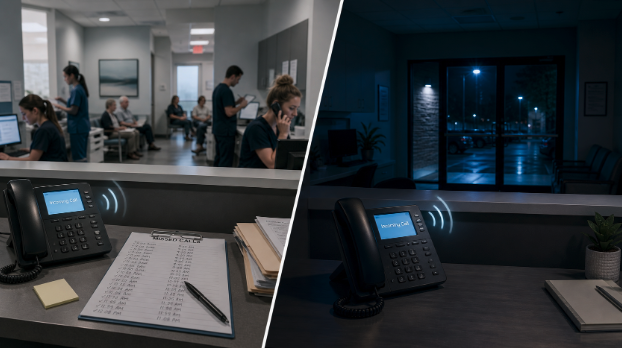
What a Missed Revenue Audit Actually Is
After working with over 500 medical practices across 28 healthcare verticals, I can tell you with complete confidence that missed revenue is the single most common and most fixable issue I find inside clinics of every size. The money is already there. It is just leaking out through gaps that most practice owners do not even know exist.
A missed revenue audit is a structured review of every place your practice loses money before that money ever touches your books. It is not about billing errors or insurance denials, although those matter too. It is about the revenue that should have walked through your door but never did because something in your system failed to catch it.
There are four main categories I look at in every missed revenue audit I run: missed and unanswered calls, unanswered after-hours inquiries, unconverted inbound leads, and no-shows that never rebooked. Every one of these represents a patient who was interested, took an action, and got nothing back from your practice. Each is a recoverable loss, and together they add up to numbers that genuinely shock clinic owners every single time.
Step One: Audit Your Missed and Unanswered Calls
Log into your phone system dashboard and pull the last 30 days of call data. You are looking for two things: calls that went to voicemail and calls that were abandoned before anyone answered. Multiply that number by your average new patient value. That is your monthly missed call revenue exposure, and most practices are stunned the first time they see it.
A regenerative medicine clinic I work with had 47 missed or unanswered calls in a single month. Their average new patient value was $1,400. That is over $65,000 in potential monthly revenue that evaporated before anyone on their team ever had a conversation. They thought their phone system was working fine. It was. The problem was what happened when nobody picked up.
After Justin Healthcare AI helped them implement an AI-powered missed call text-back system, every missed call received an automated, personalized text response within 60 seconds, including a direct link to book. In the first 30 days they recovered 31 of 47 leads. Within 90 days monthly revenue had increased by $43,000 with no change to marketing or advertising.
Step Two: Audit Your After-Hours Inquiries
Pull your last 30 days of after-hours web inquiries from your website analytics, contact form submissions, and social inbox. Then check your CRM and see how many received a response within two hours. Research consistently shows that leads contacted within five minutes are nine times more likely to convert than leads contacted after an hour. After 24 hours, most are gone.
For the same clinic, 38 percent of all inbound inquiries were coming in outside business hours. Of those, zero were receiving a same-day response. They were all getting callbacks 12 to 16 hours later. A significant portion had already found another provider by then.
The fix was a HIPAA-compliant automated response workflow that acknowledged every after-hours inquiry within 90 seconds, answered common questions, and offered a direct link to self-schedule. After 60 days, after-hours lead conversion improved by 68 percent. Same leads. Same marketing. Better response time. (See our guide to HIPAA-compliant AI tools for the compliance layer behind this.)
Step Three: Audit Your Unconverted Leads
Pull every lead from the last 90 days that did not result in a booked appointment. How many received only one or two follow-up attempts before your team moved on? How many fell through the cracks entirely after the first call went to voicemail?
The average medical practice follows up with a lead only 1.3 times before moving on. The average patient requires five to seven meaningful touchpoints before they make a healthcare decision. That gap is where most of your lost revenue is living right now.
For our regenerative medicine client, the 90-day audit revealed 112 inquiries with two or fewer follow-up attempts. We built an AI-powered follow-up sequence that automatically contacted each lead over a 10-day period through personalized text and email. Twenty-nine of those 112 leads converted into booked appointments, a 26 percent reactivation rate on leads that would have been permanently abandoned, generating over $40,000 in new patient revenue.
Step Four: Audit Your No-Show Reengagement
No-shows are one of the most accepted revenue losses in healthcare. Practices schedule around them and build buffer time because of them, but almost nobody goes back and tries to recover them systematically.
Pull your last 30 days of no-show and late cancellation records. How many of those patients received an immediate same-day outreach asking them to reschedule? For most practices, the honest answer is zero. They were noted, replaced when possible, and forgotten.
For our clinic, the no-show rate was 22 percent. We deployed an automated message within 30 minutes of every missed appointment, empathetic in tone, with two or three rebooking options and a frictionless flow. Within 60 days the system recovered 34 percent of all missed appointments, the no-show rate dropped from 22 to 14 percent, and monthly revenue increased by an additional $27,000. Tools like AI patient scheduling make this kind of automation possible without adding headcount.
Adding Up the Real Numbers
When we put all four audit results together for this regenerative medicine clinic, the picture was impossible to ignore. Missed call recovery was worth $43,000 per month. After-hours lead conversion improvement added another $38,000. No-show reengagement contributed $27,000. Lead reactivation added tens of thousands more on top.
The combined result after 90 days was over $127,000 in monthly revenue added to a practice that had not changed its marketing budget, its advertising, or its staffing. Every dollar was already theirs. It was just leaking.
None of this required new patients. It required better systems for the patients who were already showing interest. That is the difference between a practice that fights for growth and a practice that builds infrastructure for it. Want a personalized score across these gaps? Take the free 5-minute AI Readiness Assessment.
The AI Systems That Close Every Gap Permanently
AI-Powered Missed Call Text-Back: Every missed call triggers an immediate, personalized text within 60 seconds with a direct self-schedule link. Works 24/7, including holidays. Fastest payback period of any system I deploy.
After-Hours AI Intake and Booking: Captures every inquiry that comes in outside business hours, answers basic questions, qualifies the lead, and puts the appointment directly on the calendar without staff involvement. Pair this with a healthcare AI chatbot on your site for full coverage.
Automated Lead Follow-Up Sequences: Reach every new lead multiple times across text and email over 7 to 10 days. Each touchpoint adds value. Combined with a reactivation campaign for older unconverted leads, this is typically the largest revenue impact of any system I implement.
No-Show Reengagement Automation: Within 30 minutes of every no-show, a warm automated message goes out with effortless rebooking, attempting contact up to three times over 48 hours. Recovers 25 to 35 percent of missed appointments in most practices.
The Specific AI Tools I Teach Clinic Owners to Use and Implement
Knowing which systems to build is one thing. Knowing which actual tools to use and how to configure them correctly for a medical practice is a completely different skill. This is where most clinic owners get stuck on their own. The tools are not the problem, the setup and strategy behind them is. Part of what we do at Justin Healthcare AI is teach you exactly which tools to use and how to implement them inside your specific practice.
ChatGPT for Healthcare: OpenAI's purpose-built version of ChatGPT for medical and clinical environments, with healthcare-specific guardrails and clinical context awareness. Powerful for generating patient education materials, policy documentation, and internal communications. Learn more about OpenAI for healthcare.
ChatGPT for Clinicians: Built specifically for the clinical workflow of physicians, clinical decision support, differential diagnosis exploration, literature review, and SOAP note documentation at the point of care. Most doctors recover two to four hours per day once integrated correctly. See ChatGPT for Clinicians.
ModBot AI: A set of AI-powered employees that handle lead qualification, appointment booking, automated outreach across calls, texts, and email, database reengagement, and post-call nurture. Practices typically see a 30 to 50 percent increase in qualified leads within 90 days. Explore ModBot AI.
Mod Chat AI: Turns your website from a passive brochure into an active lead conversion engine. Tracks every visitor, scores intent, proactively engages, qualifies, books appointments, and hands off warm patients via live video. Closes the gap on the 97 percent of visitors who would otherwise leave without converting.
AI Lead Generation: A fully managed system using intelligent chatbots, predictive analytics, and automated follow-up to capture, qualify, and convert new patient leads 24/7. Real-time lead scoring routes only qualified inquiries to your team. Most practices see a 3 to 5 times return on investment within 90 days. We tie this directly into healthcare automation workflows for end-to-end coverage.
What the Audit Tells You That No Marketing Report Ever Will
Every practice has a marketing report. They know their cost per click, their reach, their monthly new patient count. But almost none of them have ever calculated what their missed follow-up rate is costing them, added up the no-shows that did not rebook, or looked at their after-hours response time.
If your practice is losing $80,000 a month to recoverable revenue leaks and you respond by spending more on advertising, you are filling a bucket with a hole in it. The hole has to be fixed first. In my experience, fixing the hole is always faster, cheaper, and higher ROI than finding more water.
The audit takes less than an hour with data that already exists inside your practice. The numbers will be uncomfortable. That is normal. But they will also show you exactly where to focus first.
How to Prioritize What to Fix First
Once you have completed your audit, rank the gaps by largest revenue opportunity and fastest path to a fix. In most practices, missed call text-back wins on both counts. It is the fastest to implement and results show up in the first month.
The typical priority order from there: after-hours inquiry response next, then automated lead follow-up sequences, then no-show reengagement. If your audit reveals that all four categories are significant, that is good news. It means there is a large, defined opportunity sitting inside your practice right now, and the path to capturing it is clear.
For practices that need an internal owner of this transformation without a full-time hire, a fractional AI officer can run the whole sequence end to end.
This Is Exactly What I Do for Medical Practices Every Day
At Justin Healthcare AI, I work exclusively with medical practices to design, build, and deploy HIPAA-compliant AI systems that close revenue gaps like the ones above. I started in this industry in 2017 as an operator, not a marketer. I know what the front desk is dealing with at 5PM on a Friday, and I know what it costs when the systems are not working.
Through ModFXMedia and Justin Healthcare AI, we have helped over 500 medical professionals across 28 specialties implement AI systems that have driven more than $18 million in revenue. The starting point is always the same: figure out where the money is leaking before you spend another dollar trying to bring more in.
Start with the free 5-minute AI Readiness Assessment to see exactly where your practice stands across 5 key dimensions. Or book a free 30-minute 1:1 strategy call and we will look at your specific numbers together.